Pages

Showing posts with label Assignment 3. Show all posts

Saturday, 22 February 2014

Project 7 - Theme Book

I have been thinking about my Theme Book on and off for quite a long time.  I have found it quite difficult to decide on the subject.  I wanted it to be personal to me; something that inspires me often. 

I started with a mind map - based on ME!  I wrote down anything that I could think of that was part of my life.


After looking at all the ideas I decided that my garden features quite heavily in my work and photographs already and as I am outside everyday that this would be the best choice.  I made some notes about ways to develop this theme and a few sketches for ideas for a final piece.

I then looked back through some of the photographs I had taken of my garden.


I had also already used my garden as inspiration in my sketchbooks.


I find all the images inspirational and I could use any of them I think as a starting point, so I had to decide which were my favourites, this was very difficult but in the end I decided on the funghi and blue & white fragments.


I then started to collect fabrics ...


... and resources; threads, yarns, pens, pencils, beads, buttons, inks, crayons and anything else I could find that fitted these images.


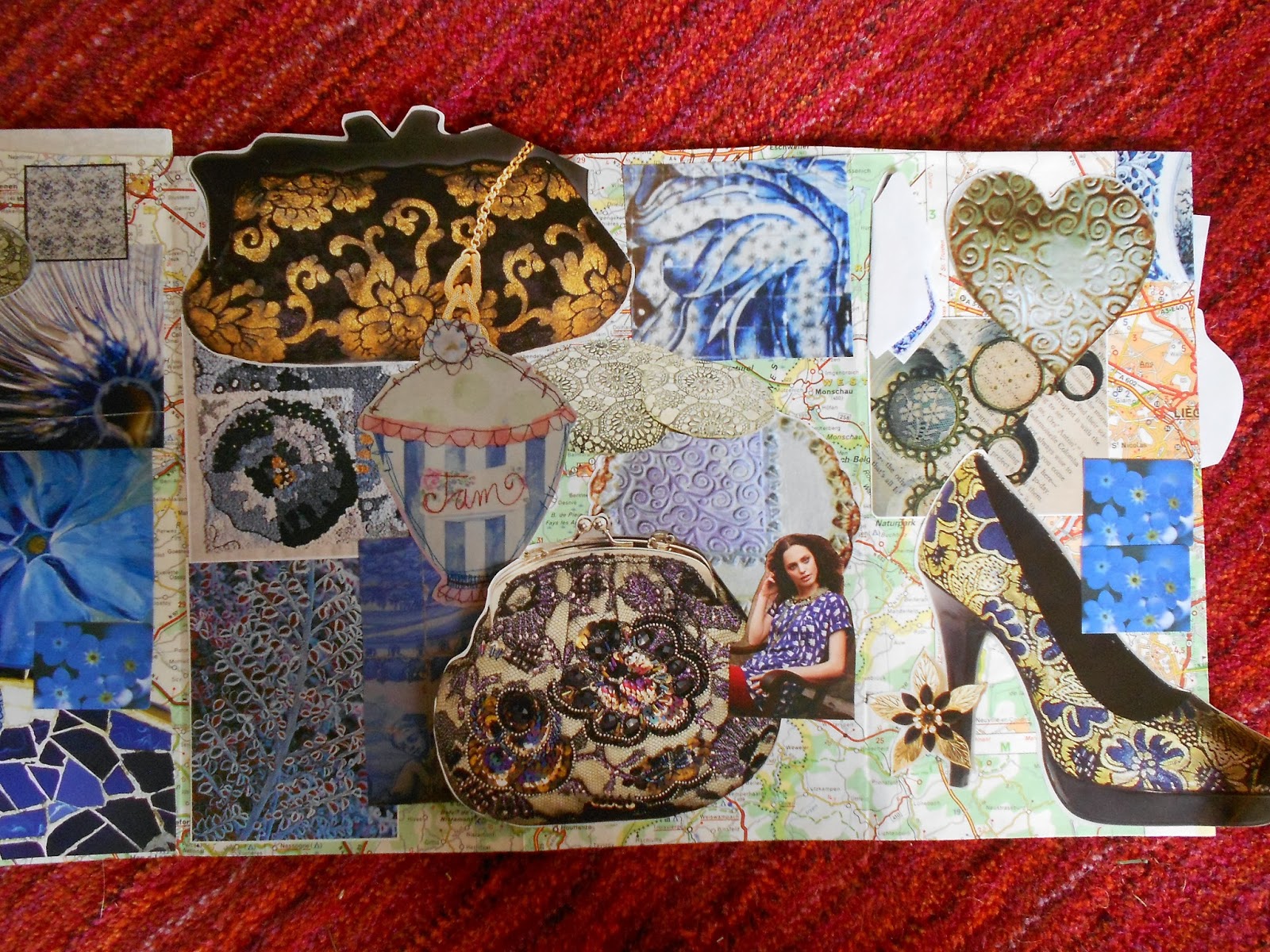
I also started a collection of images from magazines, my scrapbooks and the internet that I felt suited the themes I had chosen.


I am happy with the choices I have made for my theme book - FUNGHI & FRAGMENTS.

Thursday, 28 November 2013

Assignment 3 - Tutor Report

Overall Comments
The project work you have completed shows the extent to which you are beginning to recognize that you have a personal style and a particular way of working. There is a clear link between work in your sketchbook and the identification and development of possible starting points for your design ideas. Your visual awareness as well as an increasing fluency with design based work is becoming increasingly evident as shown in stage two and this is backed up by the connections you make with wider artistic and intellectual concerns. Your technical skills continue to develop and the work you have completed shows a concern for the presentation of outcomes in an accessible way. In your next assignment, try to maintain the documentation of your working practices and to continue to reflect on more specific aspects of your progress.

Feedback on Assignment
Project 6 Manipulating Fabric: Creating Shapes and 3D Forms 
Aims: 
  • To explore how work from your sketchbook can be used a starting point for the development and realization of your ideas
  • To explore different ways in which stitch can be used to assemble fabrics and hold structures together
  • To experiment with a range of 2D and 3D fabric manipulation techniques and processes
  • To gain an understanding of the diversity of style and design in textiles
  • To consider why craft produced textiles maintain a place in our society

Stage 2: Exploring Ideas
I liked the way in which you focused your experimentation on just two images here. You took a focused approach with each in that the horseshoe photo led you to work directly with materials to hand and to use their qualities to explore the surfaces seen in the photo. By contrast, the barnacle image led you to explore further possibilities by digitally manipulating imagery. Did you have a preference here in terms of preferred ways of working? A further extension of this preliminary work could have been some smaller focused drawings or collages in your sketchbook. This would have been a good reference point for further experimentation with applied fabric techniques. There are close links here in terms of how you work with shape and line in compositional terms. There was also some interesting sampling based on word and colour association and the results showed a good understanding of the extent to which your choice of fabric and colour can create a particular mood or feeling.

Stage 3: Applied Fabric Techniques
The first two samples based on your horseshoe photo were lively and well considered. There was a robustness and crustiness about them which you achieved by carefully building up the layers of fabric. It was a good example of where the addition of braids etc. is fully justified in achieving your intentions. You might like to have a look at Lez Brotherstone’s costumes for Sleeping Beauty. Look at how he uses layering and combining different fabrics. See link below and click on View the Gallery to see the gothic fairy costumes

www.new-adventures.net/productions/sleeping_beauty/reviews‎

It was also interesting to see what happened when you began to manipulate the barnacle photo further. The structure became very lace like and delicate. Could this lead you to further research? You might like to look at Michael Brennand Wood’s Material Evidence, Improvisations on a historical theme based on the Whitworth Art Gallery’s collection of lace. It might lead you to further experimentation with materials and techniques. There is also a good link here between this and the crochet work you undertook for Alice Kettle.

You are becoming increasingly aware of how subtle changes in your images can be used to create very different outcomes. I’m thinking here of the contrast you achieved when selecting hard contrast imagery as opposed to a softer focus. In all your samples, you relied very much on fabric quality to achieve the overall effect. It was interesting see that by contrast, you used only very basic utility stitches to assemble fabrics and hold structures together. Was this a conscious decision on your part?

The diversion into stained glass allowed you to capitalize on the use of semi-transparent fabrics and the sample in which you combined the printed background with overlaid shapes worked very well indeed. The reference to Klimt’s work was very self-evident but you might also like to look at Frederich Hundertwasser for his use of rich pattern and simplified, distorted shapes.

Final Sample
This piece was technically very well executed, showing pleasing evidence of your ability to apply what you had learned through developing your design ideas and subsequent sampling. However, I thought it had a heavy solidness about it which didn’t really reflect the qualities of your starting point. It seemed a little overworked and this was exaggerated by the very solid circled shapes, firmly enclosed and held down with the blanket stitch. Compare this with some of your freer more delicate sample where you used a lighter machined stitch to secure your shapes. The background by contrast was rather more sensitively handled with some good layering and the use of running stitch which served to secure the layers as well as create additional surface texture. You might like to re consider this piece in terms of alternative approaches. Could you for example, insert some of the shapes underneath the top background layer? Would further consideration of varying the scale of the shapes in terms of larger and smaller circles help you to re consider the overall composition and the relationship between positive and negative shape?

Stage 4: Surface Manipulation
You produced some very interesting samples for this stage. I particularly liked the slashing and the way in which you varied the distance between the rows of stitching. This allowed a denser buildup of frayed, coloured threads to emerge on the surface. You could take this experimentation further by trying the same techniques but with different fabrics. You might also like to look at Elizabeth Brimelow’s work. She used slashing very effectively in her quilts but cuts on the bias of the fabric within an enclosed stitch area. This effectively prevents the fabric from fraying at all but reveals slashes of pure colour reminiscent of Elizabethan costume.

The moulded samples were highly successful too. I felt as though the beige hairy sample was actually growing whilst I was looking at it!

Final Sample
This was a really good choice of technique to re-create your barnacle photo. I liked the way in which you create different surface heights by using French knots as an intermediary level. My only reservation was again in relation to the overall composition. You could maybe re consider more carefully the spaces created in-between the barnacles. Would less be more? You can exaggerate elements within the original photo to suit your purpose rather than trying to achieve a direct copy. Could you introduce some darker tones with your French knots in order to create an illusion of greater depth and tonal contrast?

Preparation for Project 7: Theme Book 
Your theme of ‘Gardens’ is a good one with lots of potential but you need to focus in more closely on a particular aspect otherwise, it will become unmanageable. Also, think very carefully about everything you have learned so far in terms of materials, techniques, observational skills, visual awareness design and compositional skills and try to demonstrate how you intend to build on this. Don’t be overambitious. Often a simple design well executed can work much better than something which is overcomplicated and maybe beyond your current level of expertise. Remember, it’s a level 1 module. Again, reference to Elizabeth Brimelow’s work in terms of subject matter might help you here.

Learning Logs/Critical Essays 
References to artists’ work and exhibitions are thoughtfully considered. Try to link this more loosely to the development of your own ideas e.g. you clearly loved Gillian Bates’ work. What elements might you consider developing in your own work?

Research Point 
This was a very interesting choice and one which resonated with your own personal interest. You mad some pertinent references to the ways in which the craft of crochet has been incorporated into the work of current designers and the general revival of the craft through retro and vintage revivals.

Sketchbooks 
More work is need here but I think you know that from your comments in your learning log. The work you have undertaken for your art class has clearly had a beneficial effect on your OCA work but remember that you cannot submit it as part of your assessed course work. It might be better to keep it in another sketchbook unless the techniques you have acquired feed specifically into the development of new ideas for your OCA course.

Suggested reading/viewing 
See above in report

Pointers for the next assignment 
The next assignment is concerned with the construction of textiles. Some of the weaving techniques can be quite time consuming and the intention is to familiarize you with the techniques and processes. My advice would be to keep your samples quite small and when asked to identify possible starting points, don’t be tempted to go down a very literal or representational route. It is very challenging to do this because of the structure of the weave which favours a geometric or linear approach. Also, consider what other non-traditional textile materials you could weave with and in what ways you might combine their use.

Thursday, 9 May 2013

Research Point - Why Do Craft-Produced Textiles Maintain a Place In Our Society

I love to crochet.  I taught myself, from a book, when I was about 11 and, at the age of 17, I made my first granny square blanket and have made lots of them since then.  My eldest daughter (late 30’s) does not like them at all - won’t even have the brightly coloured cot or pram versions - she thinks they are old fashioned and “granny-ish”; but my younger daughter (early 20’s) can’t get enough of them.  When she recently moved into her first home, she requested a turquoise/brown/cream retro style one for her sofa and then a purple/red/cream one for her bed.  Having just had a baby, she is now on the receiving end of pram/cot/mini versions and she loves them all.  She doesn’t think they are “grannyish”; just retro, funky, fashionable and unique.


I crochet because it is very relaxing.  It also grows very quickly and is very portable.  If the project is granny squares then it is the perfect project for the long winter evenings – because you can snuggle up under the developing blanket whilst you are crocheting it – FAB!


The interest in crochet is definitely on the increase and it does seem to be quite fashionable at the moment - although this could probably be because of the popularity of vintage/retro designs.  In the current economic climate our spending has been squeezed to be almost non-existent, so people are turning to do-it-yourself and taking up traditional crafts to create unique items for themselves and their homes. 


In recent years crochet has been seen on the catwalks of Missoni, Paul Smith, Kenzo and Dolce & Gabbana, to name but a few and looking on the internet produces a vast array of crochet items for sale, or patterns to buy, or free patterns to make your own in any possible choice you could wish for; but really, unless you are at the top of the market - with a Dolce & Gabbana crochet handbag retailing for around $2900! - the intense work involved in producing a crochet item (and the cost of the yarn) doesn’t make it very profitable.  The best idea probably is to write a book.


I think there will always be a place in the market for hand crafted products of any description.  People will always want individual, unique items – whether clothing or items for the home – and certainly hand-made for babies cannot be bettered.  For my grandson I make all kinds of cardigans (both knitted and crocheted) – that aren't found in the shops – little granddad cardi’s with shawl collars and vintage leather buttons.  I don’t think they would be particularly profitable, but I am convinced there would be a market for them. 


I think in this day and age of instant, disposable excess the need to get back to a much simpler past appeals to a lot of people.


Assignment 3 - Reflective Commentary

It is again time to reflective on my progress so far.  I have enjoyed working on this assignment, but once again life seems to encroach on my time and it has taken me far longer than I anticipated.

I have worked on samples using techniques that I have never tried before - smoking and furrowing.  I preferred doing the smoking on the check fabric so that I didn't have to mark the grid on the reverse of the fabric.  

I have decided that I am not a very neat person, but am definitely a colour and texture person.  I love creating texture and colour - with layers of sheer fabric and with lots of stitching.  I think the running stitch background on both of the final sample pieces has worked really well.  This is something I will be using again.

I have found drawing in a sketchbook very difficult this time and I am really going to have to concentrate on doing more drawing for the next assignment.  

I am really looking forward to starting Project 7.  It has been difficult to settle on a final topic, but I think now that I have decided to use my garden as inspiration.

Project 7

THEME BOOK

This has been going around in my head for a long time now.  I have had lots of ideas - but didn't seem to be able to decide what to choose.  I had a look back through some old exam papers at night-school and noted down any starting point ideas that appealed to me.

I sat down and wrote down everything in my life and did a brain-storm with ideas - but I just kept coming back to the idea of my garden.  I live in a beautiful rural part of mid-Wales and my garden is not necessarily full of flowers but it is full of inspiration, so I have chosen that as subject for my theme book.

I have recently purchased two book by Frances Pickering and found her work very inspirational.  I am going to experiment with some of her techniques and see where it leads.

http://www.frannyp.co.uk

http://www.amazon.co.uk/Under-Cover-Paper-Fabric-Books/dp/0957351100/ref=sr_1_1?ie=UTF8&qid=1368083100&sr=8-1&keywords=frances+pickering

http://www.amazon.co.uk/Page-After-Making-Individual-Journals/dp/0955404843/ref=sr_1_2?ie=UTF8&qid=1368083100&sr=8-2&keywords=frances+pickering


Lots and lots of inspiration - through the seasons - shapes - seed heads - textures - forms - colours - line - endless ideas - can't wait to get started.

I also created a Pinterest Board to collect ideas for Assignment 5.


Wednesday, 8 May 2013

Research Point - Gillian Bates

My tutor suggested I look at the work of Gillian Bates and I'm glad I did.

Gillian is a textile artist based in Eastbourne, East Sussex.  She takes her inspiration from the surrounding seaside towns (the residents and architecture), holiday advertising, old postcodes and vintage footage of seaside holidays - producing quirky images of bandstands, helter-skelter, beach huts, 99's, carousels and deck-chairs.  


She produces lovely, nostalgic textile images; very intricate black machine embroidered glimpses of everyday seaside life - highlighted with bright coloured pieces of fabric.  On a background of plain cotton drill, she draws her images, freehand with needle and thread, creating pops of colour with fabric - a mix of recycled, vintage and new - to create beautiful art canvases.


I really like these textiles pictures.  They look fairly simple, but when you examine them closely they are really quite detailed.  I love the sudden pops of colour.

Link to website: http://www.gillian-bates.com/index.aspx


Research Point - Alice Kettle

I saw on Facebook that the UK textile artist Alice Kettle was looking for members of the public to help her with a new installation.  After emailing her, I received a pack of materials and instructions through the post – very exciting!


Alice explained that she was making 3 installations for the Queens House, National Maritime Museum - due to be installed during the second week in March 2013.  
  1. A portrait of Queen Henrietta Maria
  2. Garden of England flower installation which takes floral motifs from the clothing in the portraits of Queens and courtiers
  3. A hanging approx 10m high in the centre of the Tulip stairs, using the lace work from the collars and cuffs of the lacework in the displayed portraits
The Tulip staircase installation was the one she was asking for help with, the others she was creating herself.  The installation uses the starting point of the tulip motif echoed in the metal banister which is a cross between a tulip and a fleur-de-lys.  Also the motif of Queen Anne’s lace; which is a lacework based on the flower (which is like cow parsley).  Alice explained that she needed lots of flowers to make a floating cascade in the centre of the tulip stairs.


Instructions on what to make:
  • Use your initiative and be as creative and inventive as possible
  • As the work is so big I can use everything and anything
  • Stick carefully to a design or
  • Develop and elaborate 
The only things to bear in mind are:
  • The main references as described
  • Lace is the starting point, light airy and open, no cloth
  • Don’t use too much wire as I am concerned with the overall weight
  • The whole work must be white, can include little bits of black and silver
  • No wool or silk to be used

Alice said that she was basing the installation on the collars, and by asking for flowers and shape contributions from everyone, she could connect and make everything into a huge piece.  She intended to make the structure to which all your parts/flowers/motifs will be attached.

She enclosed pictures of how they made the lace collars. These had wire shapes which then had fabric or needle lace worked around them.

Design
This was fairly open and included any or all of the following:
  • Use the wire to make individual flowers which can then be worked into with needle lace.  The fleur-de-lys will echo the banisters and the other flowers are like cow parsley
  • Use the design drawings attached to copy, or draw your own -  each flower head up to 6cm across or smaller
  • As above but make something that combines floral motifs from the various enclosed references of motifs into a bigger combined shapes - develop and let this grow 
  • Use the design drawings attached to copy, or draw your own each flower head not more than 6cm across
  • Either draw it out or just let it grow organically
  • If you don’t want to use wire, just make some floral motifs in threads - size as above.
I had never done needle-lace before, so had to Google the instructions.  I found it quite fiddly, and mine wasn't very neat, but as Alice had said that anything goes I thought it would probably be OK.  I only made as many pieces as I had wire for – which was 5 and then I made loom flowers with the rest of the yarn. These were very simple but I think they turned out very well.  It was a bit boring doing the same thing over and over again but having seen the finished piece it was worth it.


This was a very enjoyable project to work and gave me a small insight into the work of a professional textile artist.  I looked at the installation of the internet and it looks brilliant.  It is a massive installation and to think it is made up of very small parts – all posted to Alice from all over the country – I think I can see some of my flowers in there!